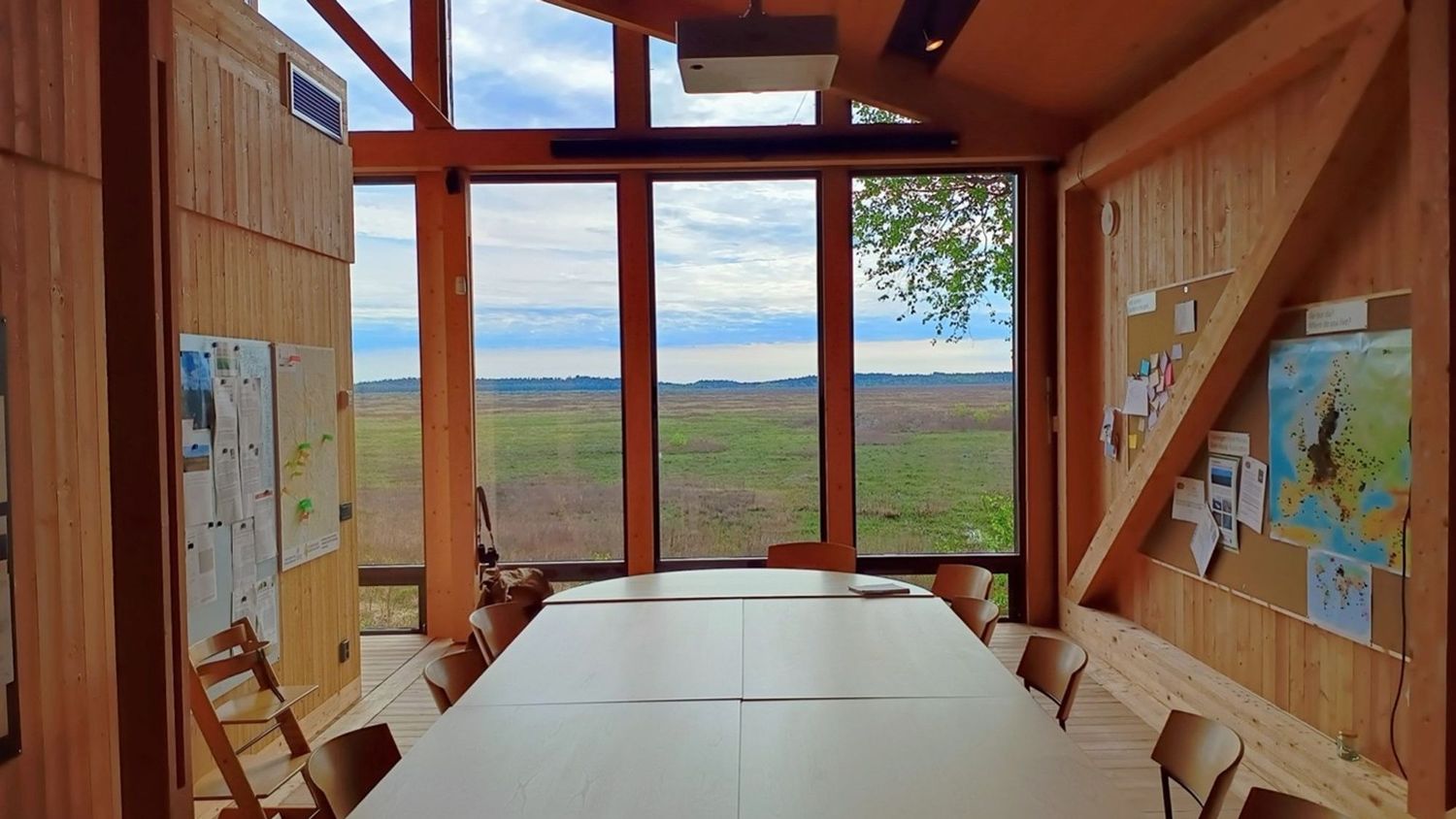
Hero Image: Visitor Centre at the Store Mosse National Park (Credit: James Cosier)
The below is a blog post of reflections from James Cosier, Lead for WP2 Engaging Communities, after his visit to the WaterLANDS Swedish Knowledge Site, the Store Mosse National Park, and some additional restoration initiatives in Sweden.
A couple of weeks back, I was lucky enough to be able to squeeze in a visit to another of our WaterLANDS Knowledge Sites – The Store Mosse National Park. I lined up the trip to be able to tag along to see some more interesting restoration work being led by our Knowledge Site coordinator, Gustaf Granath from Uppsala University, who is now also leading the Swedish Open Lab within the ForPeat project. On route to the Open day at the Lab event, jointly hosted by Uppsala University and the Swedish University of Agricultural Sciences (SLU), Gustaf suggested I stop in to see the restoration work that has been conducted at the Nynäs Nature Reserve.
Of course, given Prospex Institute’s role in the project, the main focus of my visit was to learn more about the stakeholders’ relationships to the wetlands and the engagement practices connected to restoration initiatives.
Before jumping into sharing some of my reflections from the trip, just want to say a massive thanks to Gustaf (along with his students Sara & Sara) for the support before and during my trip. Thanks also to all the people I talked to during my trip – I really appreciate that you took the time to share your insights.
The Store Mosse National Park
First stop in Sweden was the visitor centre at the Store Mosse National Park - and what a stunning facility it is. As soon as you step inside the wooden lodge, you’re invited to slip off your shoes and put on some cosy felt slippers. I’d love to have this at workshop and meeting venues, forcing everyone to swap shoes for slippers. The centre houses a wonderful exhibition about the park that is suitable for all ages, informing visitors about the bog and other features in the landscape but also showcasing the cultural heritage of the place and the former activities in the landscape. So even though I didn’t have time to get out hiking in the park, I still got a great glimpse into what is happening there and its history, plus with floor to ceiling windows at the back of the visitor centre offering panoramic views of the bog, I had a constant backdrop of birds flying by.
I was at the park to meet up with Carina, the visitor centre manager, and some of her colleagues who welcomed me with coffee and generously spoke with me for a couple of hours in a meandering conversation about the relationship of the community to the park among other topics.
Store Mosse was established as a national park in the 80s with a significant bottom-up push by locals and others to protect the area. That local initiative was formalised in a local association, Föreningen Store Mosse (Carina was a bit unsure on the translation but thought my suggestion of Friends of the Bog Association was a good fit). While today there is a formal management team in place (Carina and her colleagues are part of) funded by the state to oversee the park, the association continues to play an important role in the park organising events and carrying out volunteer park maintenance. Beyond the park the Association also serves to bring the community together and fosters a sense of local pride and belonging although we discussed how members of the group are older and older and its harder and harder to attract young people to join the group. Bucking this trend, another of the team from the park I spoke to, Ida, has stepped up to inject some fresh ideas and energy into the association, where she is now a board member. Ida actually has a family farm that neighbours the park so personally she’s very attentive to what happens in the park and the surroundings because it will affect how they manage their own land. Carina noted how valuable this has been that Ida now serves as a really effective bridge between the formal management team and the volunteers of the association as well as the broader community.
Alongside this more personal and embedded connection to the community, the National Park also goes beyond the obligatory requirements for such a body, holding two instead of one, open meetings annually to inform stakeholders about management plans and collect feedback.
It seems that these days generally people are happy with the Park but this was not always the case. When the restoration work in the park was being conducted as part of the Life to ad(d)mire project (2010-2015) there was a lot of concern by locals that the rewetting would erase the cultural heritage of the site. Responsive to these concerns the restoration team at the time adapted their plans, opting to preserve the remnants of some former peat mining facilities. While when the exhibition in the visitor centre was revamped a couple of years back, this too was a major focus of the new exhibition, showcasing the former activities that took place in the area. Most people now seem content with the balance between ecological restoration, and the preservation and recognition of the cultural heritage too – indeed one local who was particularly concerned about the impacts of establishing the national park and restoration works now sells their honey in the visitor centre’s little gift store.
Locals are now more concerned with restoration plans and what it means for them, not at the park but at the neighbouring peat mining site, whose licence is set to expire in 2030. It seems the foreign-owned miner - who coincidently only employs two locals, so much for local job creation narratives – has not been nearly as open and engaged as the national park was, since despite there being one meeting a few years back, no one seemed to really have a clear idea about what is set to happen with the site. Against this backdrop it is not surprising that there is quite some concern about what will happen and if private lands will be affected. Sadly, it also seems like the poor communication and engagement practices of the miner is eroding the trust developed by the park, such that there is a growing mistrust and scepticism towards restoration activities.
Nynäs Nature Reserve
At first glance I couldn't see any wetlands. I walked around the grounds of Nynäs and took in the very well laid out educational trail for children and looked at the castle and lakes – I even got excited when I saw an old distillery and thought I might finally find some wetland drinks, but alas it's now a hostel. But then Gustaf sent me some pins that took me away from the public part of the farm along some gravel roads until I came across some beautiful peaceful wetlands in the middle of the forest, complete with a deer staring at me and clearly thinking "what are you doing here?"
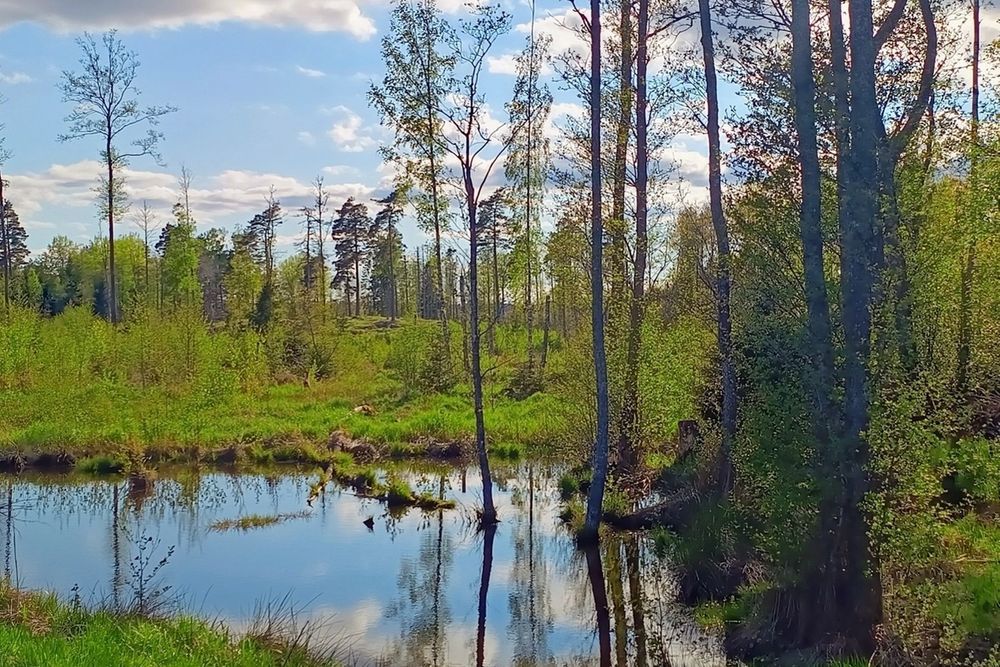
Image 1: Lake at Nynäs (Credit: James Cosier)
Didn't get a good picture of it, but there are also some upside-down trees in the lake. Apparently, the excavator driver just likes to have a little fun and thought the birds might like it as a resting place.
I had a nice chat with the mastermind behind the restoration work in Nynäs, Stephan, over the next few days, hence my insider information about the upside-down trees. But it was the bigger story he told that really struck me. The reserve covers around 3,800 hectares, including active agricultural areas, cultural attractions with large visitor numbers and beautiful natural landscapes with coastal areas, forests and wetlands. And when you talk to Stephan, he weaves all of this together into a very captivating story about complementarity and additionality that captures a wide range of the benefits that wetlands provide and also reverses many of the obvious conflicts.
So, although the castle and other parts of the estate already attract many visitors, he notes that birdwatching and other wildlife-watching websites and apps show that more and more people are now coming to the area for nature tourism. We also discussed the appreciation that people generally have for wildlife, but he said that previously there was no real space for wildlife in the area because deer and the like were considered a nuisance to farmers and foresters.
Wetlands provide such a space: my experience and the photo above are anecdotal evidence (I know the deer is there, even if you can’t see it) of Stephan’s claim that red deer love the wetlands and that they finally have a place to be in the landscape and that the more time they spend in the wetlands, the less damage they do to farmland and managed forests. He then also weaved into the conversation the benefits of fire management from restoration and their role where firefighters were able to use water from a constructed wetland to put out a forest fire a few years ago. Of course, finding the balance between different interests is easier said than done, especially in more challenging contexts where such a regional strategy requires much more coordination, but Nynäs shows that regional leadership and a vision that weaves together different sectors can be very powerful.
ForPeat Open Lab Sweden – Open day
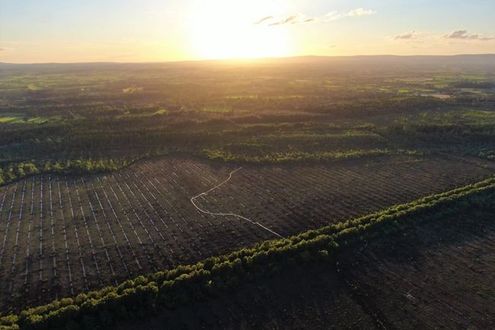
While the Store Mosse restoration represents an earlier era of wetland restoration in Sweden, nowadays efforts are afield to expand restoration outside of protected areas and on private lands too. That’s exactly what is happening within the ForPeat Open Lab in Sweden, where many of the areas being rewetted as part of the project are owned by the Swedish Church. The project is experimenting with two relatively new and somewhat controversial forestry practices in Sweden, rewetting previously drained forests and implementing continuous coverage forestry.
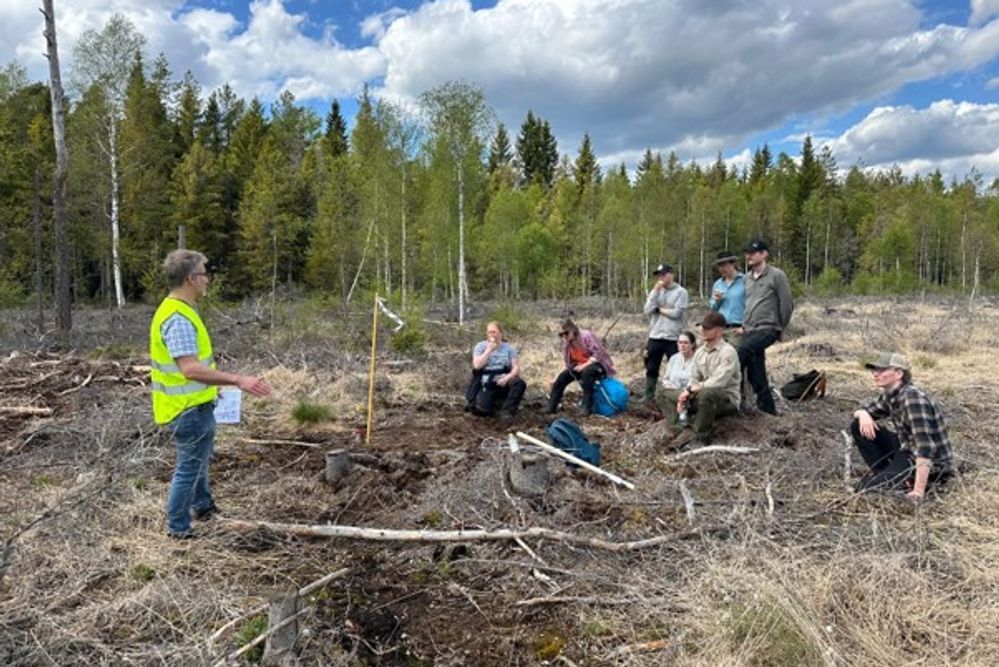
Image 2: ForPeat Open Lab in Sweden (Credit: James Cosier)
It was encouraging to see a couple of big institutional land managers such as the Church and the University of Uppsala - they’re not just a research partner but thanks to some royal endowments dating back centuries, they also manage a lot of land - taking the climate impacts of their operation seriously and leading the way in this research and innovative work. Stakeholders I spoke to agree these projects are needed and such institutions need to step up, since the situation is still such that your average forest owner does not yet see the compensation for rewetting their land as enough, and there is still quite some hesitancy and concern (i.e. increased vulnerability to bark beetle is a major concern) about shifting from traditional forest management practices. The learnings from ForPeat will hopefully thus support scaling of restoration elsewhere across Sweden.
Thank you to James for sharing his reflections from this trip, and to all the team in Sweden, for sharing their time and insights.