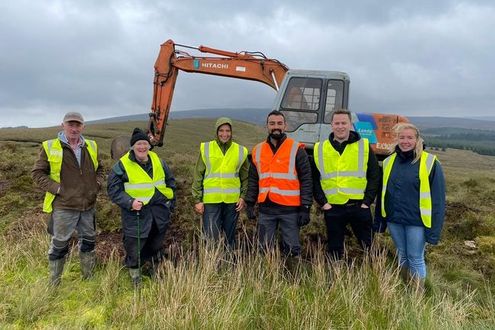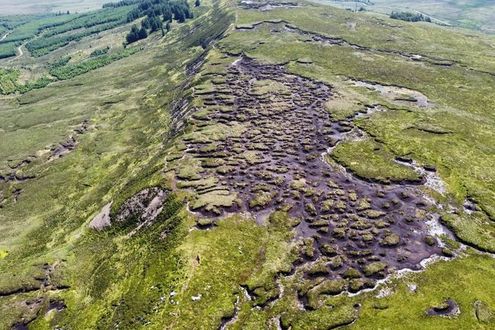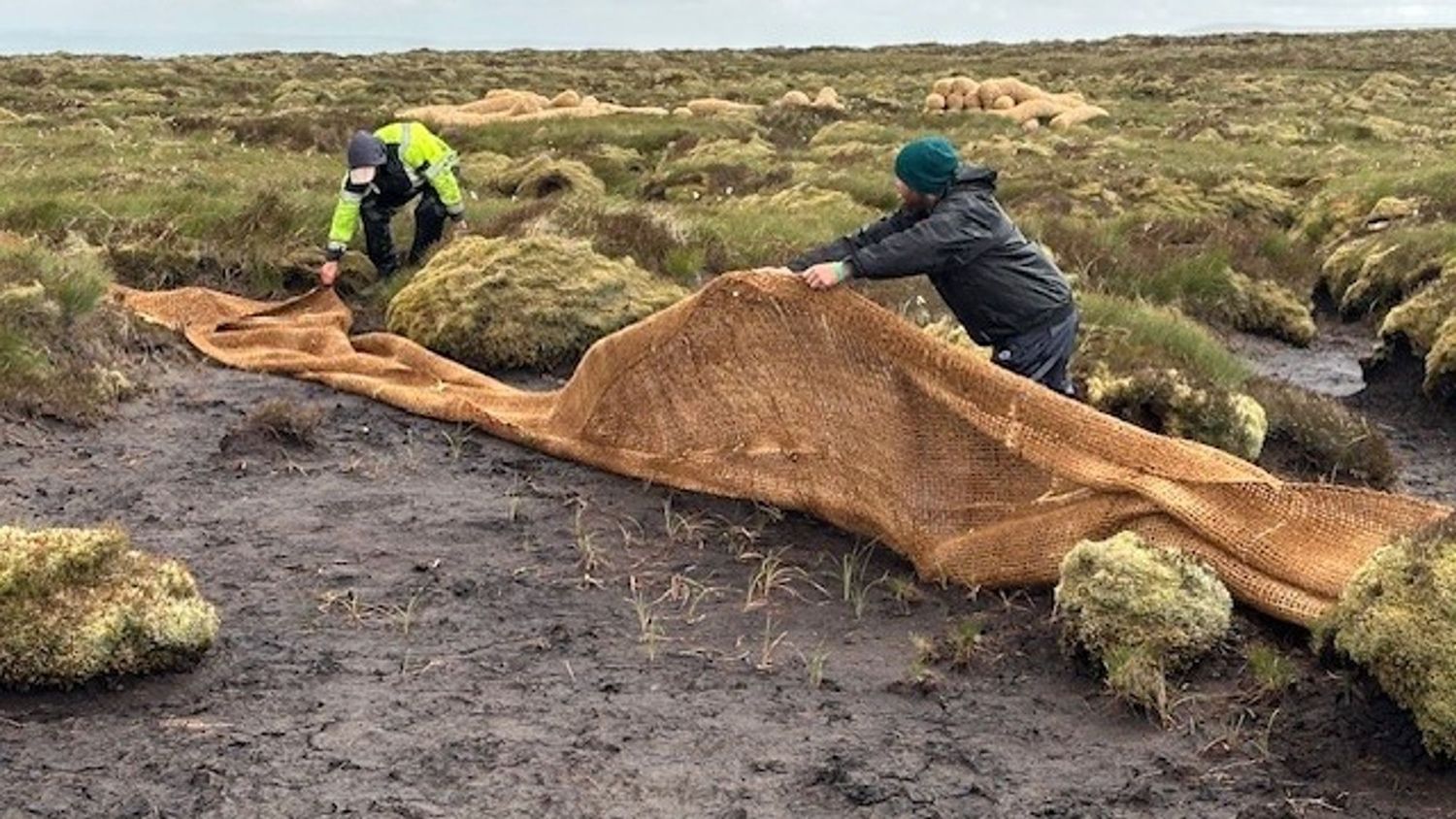
Hero Image: Use of geotextiles for peatland restoration on bare peat in Sliabh an Iarainn (Image Credit: Gary Goggins, LIFE IP Wild Atlantic Nature)
As part of WaterLANDS upscaling, project partner LIFE IP Wild Atlantic Nature from our Irish Action Site has been testing the efficacy of Results-Based Payment Schemes (RBPS) as a mechanism to deliver large-scale restoration on privately-owned agricultural land within the Natura 2000 network. The project is demonstrating how Ireland's ACRES Cooperation Project (ACRES CP), a results-based agri-environment scheme, can support peatland restoration and encourage long-term environmental stewardship.
Results-based Payments for Restoration in Sliabh an Iarainn ACRES CP is Ireland's flagship results-based agri-environment payment scheme, funded through the Common Agricultural Policy (CAP) (2023-2027, Pillar 2). Under the programme, approximately 20,000 farmers receive annual payments linked directly to the ecological condition of their land.
The 261ha upland restoration site is located on Sliabh an Iarainn (‘The Iron Mountain’) in County Leitrim, Ireland. Situated within the Cuilcagh Anierin Uplands Special Area of Conservation (SAC), the site comprises of blanket bog, wet and dry heaths and associated habitats, with an eroded summit rising to 585 m above sea level.
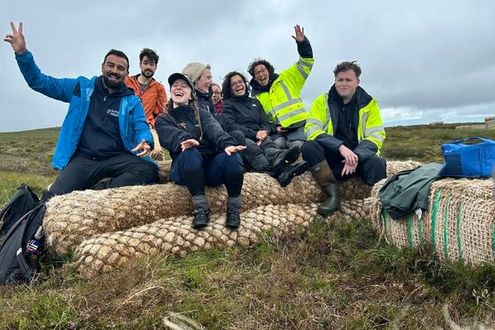
Restoration measures have focused on erosion control and invasive species management. Local workers, including farmers from the surrounding area, were employed to carry out the works and received training in peatland restoration techniques.
This approach delivered benefits beyond habitat recovery, by investing in local people and skills, it has helped build and retain local expertise and provide associated income opportunities within the community. The WaterLANDS Blanket Bog Restoration Toolkit was used as a tool within this training.
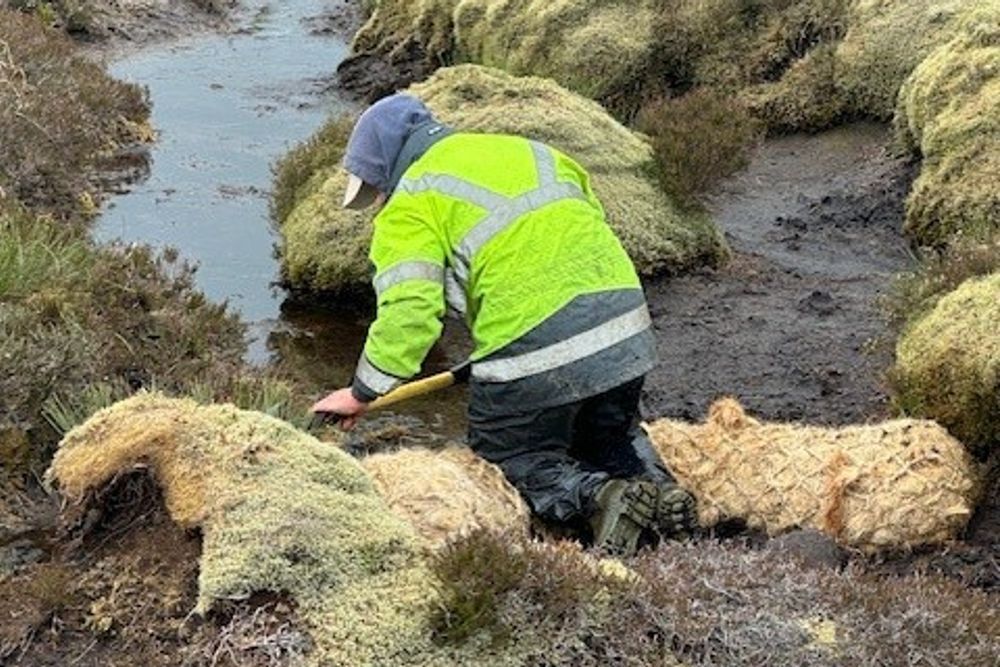
Image 1: Restoration activities in Sliabh an Iarainn (Image Credit: Gary Goggins, LIFE IP Wild Atlantic Nature)
Delivering restoration on privately owned commonage land brings particular challenges. Multiple landowners, differing priorities and complex governance arrangements can make decision-making difficult. LIFE IP Wild Atlantic Nature highlighted that clear and open communication with all shareholders and opportunities for two-way dialogue is crucial. Habitat assessment scorecards, as used in the ACRES CP programme, are a powerful tool for establishing a common understanding of threats and pressures on a site. LIFE IP Wild Atlantic Nature developed multicriteria peatland habitat scorecards, opening up avenues for discussing appropriate interventions and co-creation of restoration planning.
Working within a protected site (e.g. SAC) adds another layer of complexity. It requires extensive planning and the navigation of complex processes and procedures. Success therefore depended on a skilled multi-disciplinary workforce and collaboration with farmers, farm advisors, contractors and government staff throughout the process to move the project from planning to implementation.
Delivering Benefits for Nature and Communities
At Sliabh an Iarainn, these restoration works funded through the Shared Island Initiative Peatland Programme and delivered as part of WaterLANDS upscaling have already produced tangible benefits.
Fifteen landowners on a peatland commonage site have seen increased ACRES CP payments as a direct result of restoration actions that improved habitat condition. This demonstrates how results-based payments can create a clear financial incentive for landowners to support environmental improvement.
Environmental benefits arising from the restoration works include reduced carbon emissions from previously degraded peatlands, enhanced biodiversity, improved water quality, and increased capacity for natural flood management.
As the condition of the site improves through ongoing restoration, the habitat quality score and related payments for participating landowners increases accordingly, providing a sustained income stream associated with long-term restoration outcomes.
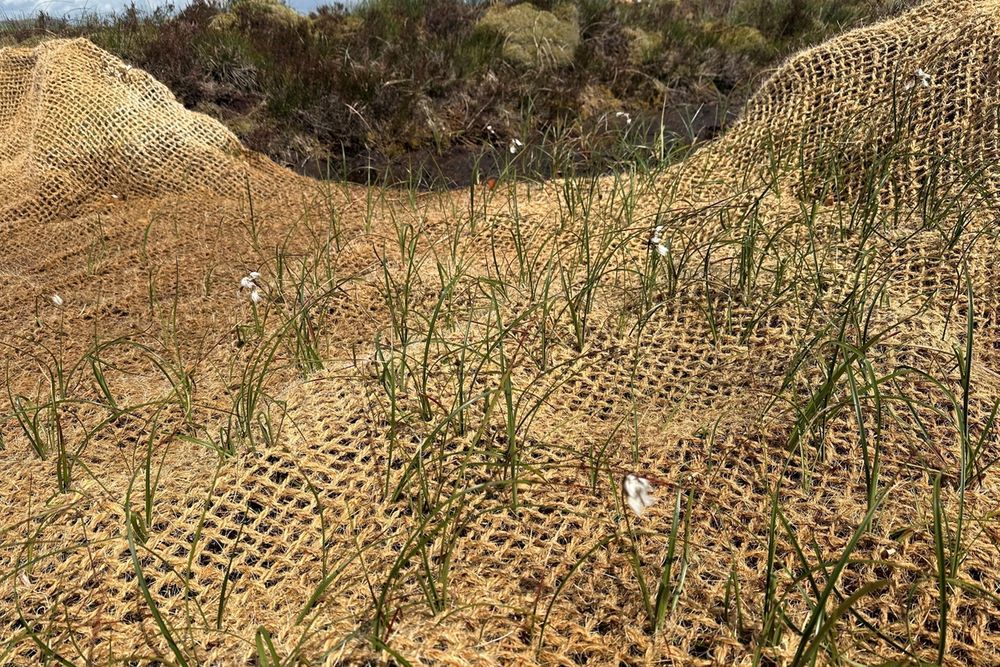
Image 2: Recolonisation of sedges on geotextile cover in Sliabh an Iarainn (Image Credit: Gary Goggins, LIFE IP Wild Atlantic Nature)
Looking Ahead
Restoration activities will continue at Sliabh an Iarainn, leading to further employment opportunities and environmental improvements including further reductions in carbon emissions, increased biodiversity, improved water quality, and enhanced flood management.
The project demonstrates that results-based approaches can be an effective engagement and implementation mechanism for delivering small and large-scale restoration, building on the evolution of RBPS in Ireland, as recently highlighted by Douthwaite et al. (2026) in the journal Agricultural Systems.
Importantly, the project also highlights how non-CAP funding can complement existing CAP-supported schemes to enable larger and more complex restoration projects. By combining restoration investment with results-based incentives, it is possible to deliver lasting benefits for biodiversity, climate resilience, water quality and rural communities.
The experience at Sliabh an Iarainn shows that peatland restoration is about more than recovering habitats. It is also about building local skills, supporting rural economies and creating long-term partnerships between farmers, communities and conservation practitioners. Through WaterLANDS and LIFE IP Wild Atlantic Nature, these lessons will hopefully shape approaches to peatland restoration far beyond a single site.