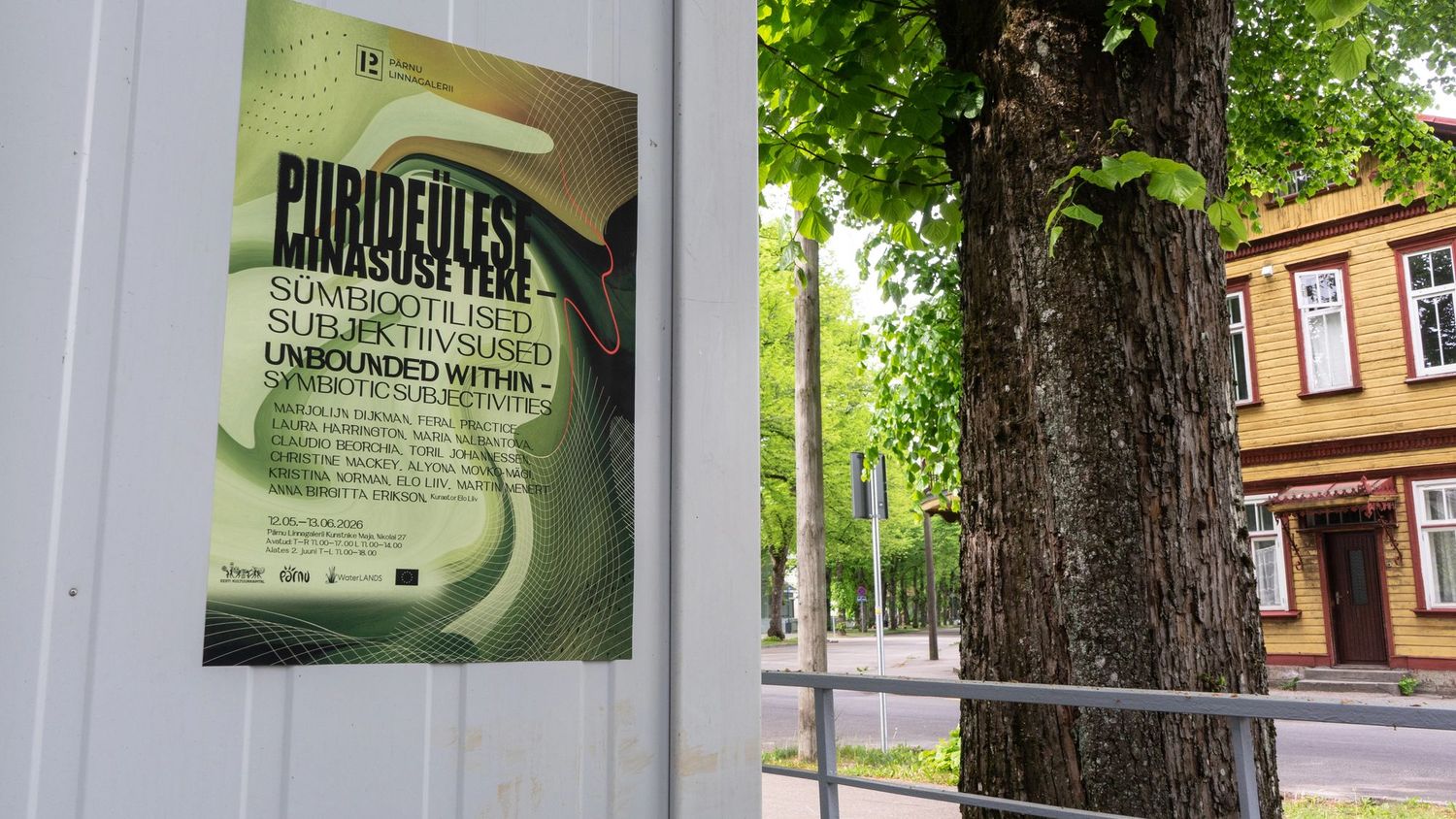
All six WaterLANDS artists in residence took part in an exhibition in Pärnu, Estonia, alongside five other artists from Norway and Estonia. The exhibition ran from 12 May – 13 June in Pärnu Linnagalerii and was curated by Elo Liiv, the WaterLANDS artist for the Estonian Action Sites. Entitled ‘Unbounded within – Symbiotic Subjectivities’, it explored the fading boundaries between humans and the environment in the Anthropocene, as ecological crisis and technological development force us to rethink our place in the world.
‘Unbounded Within – Symbiotic Subjectivities’ problematises the understanding of the self as a closed and autonomous unit in the context of ecological, social and political crises which reveal the interdependence and entanglement of life. Symbiotic subjectivity shifts the focus to relationality, replacing the concept of the ‘individual’ with that of 'accompaniment’. This is about a journey from ‘I’ to ‘we’, where ‘we’ can encompass not only other humans, but also bacteria, the fungal kingdom, the atmosphere, and mineral flows.
The WaterLANDS artists presented work – some of which is still in process - which has emerged from the residences alongside some previous material, curated with that of the other artists. Starting with their Action Sites in Estonia, Ireland, UK, Bulgaria, Netherlands and Italy, the works touch on key interconnected topics related to wetlands and restoration, such as extraction and its legacies, deep time and hidden aspects of nature, understanding care as a practice in the context of restoration, human traces, representation and memory, the modernity paradigm and data infrastructure, as well as participatory actions to reveal environmental change.
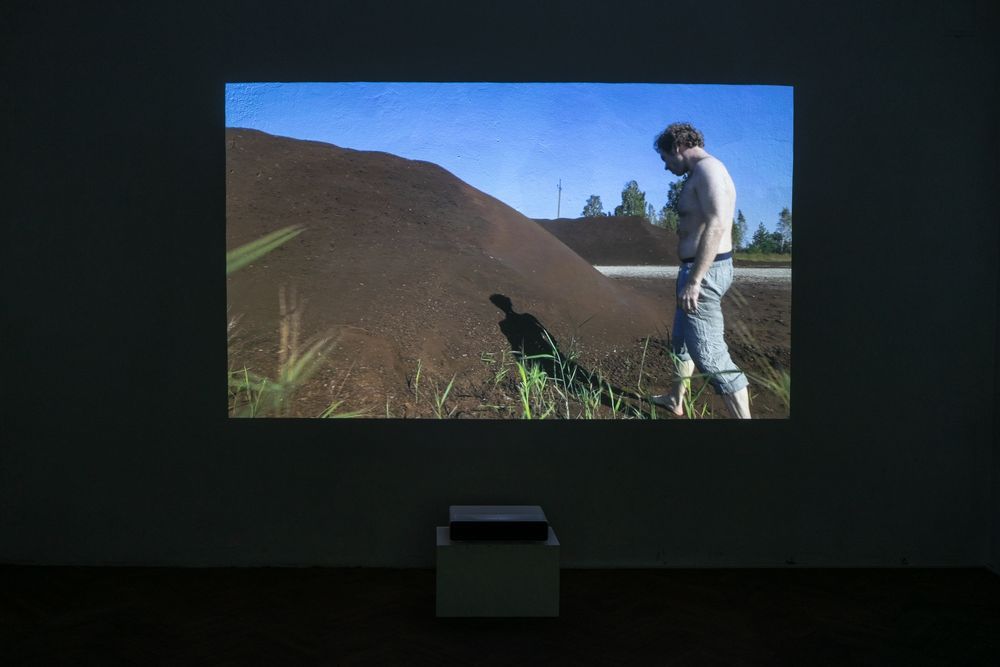
Image 1: 'Losing the Shadow' video installation by Elo Liiv (Image Credit: Anna Birgitta Erikson)
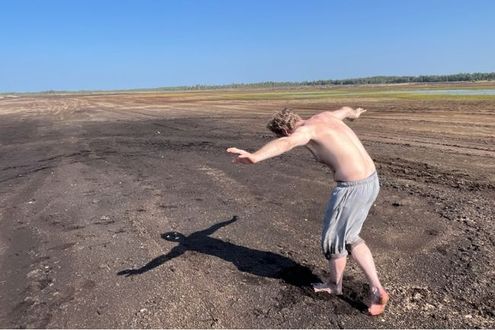
Some specific works related to and developed through the project included Elo Liiv’s video installation Losing the Shadow which addresses the long history of peat extraction in Estonia. Approximately 10,000 hectares of peatlands have been abandoned by peat producers, scarred by Soviet-era drainage ditches which turned bogs into lifeless terrain. The shadows from this history merge with today and extend to ever-new generations, seemingly impossible to escape. The protagonist of the video work, as a symbol of human society, futilely attempts to lose both the shadows of previous generations and their own shadow in the Lavassaare peatland.
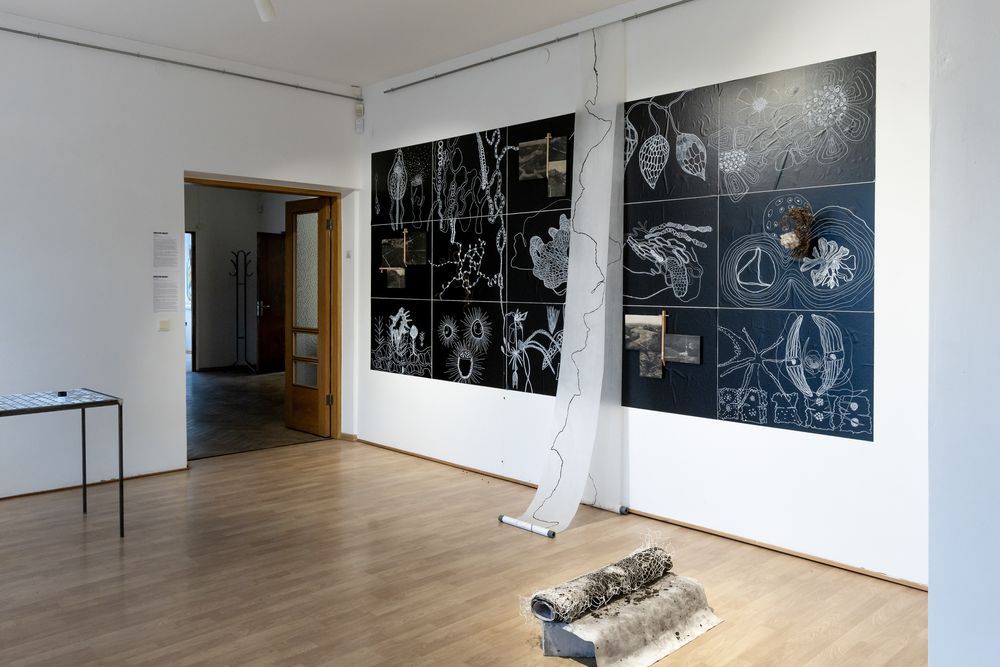
Image 2: Stellula (2026) by Christine Mackey (Image Credit: Haide Rannakivi)
Christine Mackey’s installation Stellula (2026) refers to the star-shaped structure of the capitulum in certain Sphagnum moss species. This is the first iteration of a body of work developed in response to the ongoing restoration of Bencroy, the wetland site in Ireland that Mackey has been investigating. Sphagnum studies, the large wall work, explores the cellular architecture of moss rendered in white chalk on black sheets, arranged in a grid. Layered over these are a series of photo-print works on board, as well as other elements to the installation - drawings, prints, sculptural elements and ecological materials – which the history and hidden aspects of the natural environment. Together they speak to the same deep time the bog holds, and that restoration work seeks, slowly, to continue.
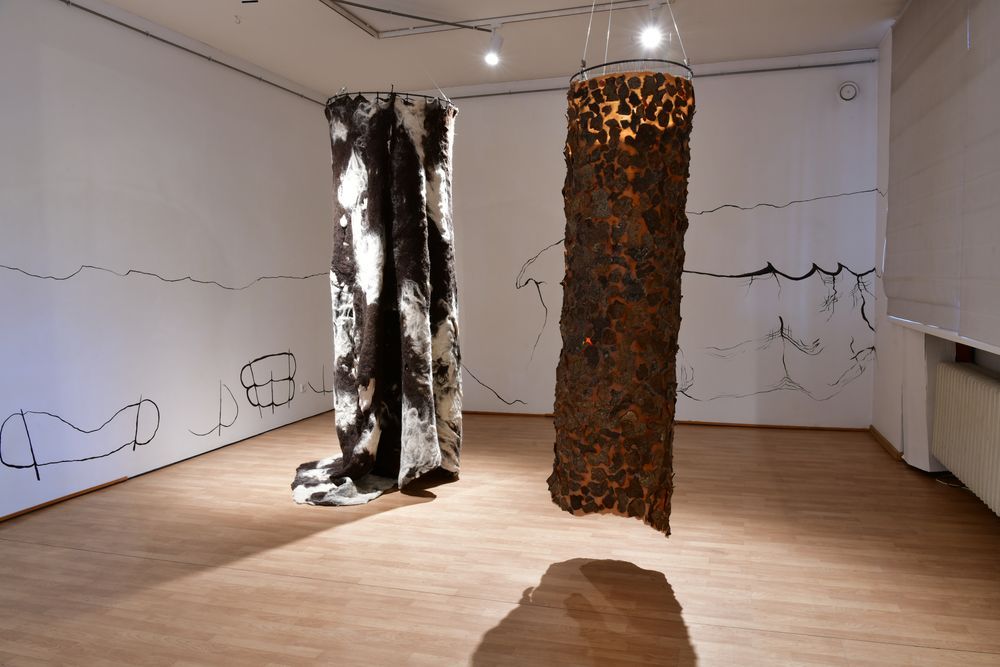
Image 3: Big Felt and Bog Pool, from Tenderbog by Laura Harrington and Feral Practice (Image Credit: Juri Vlassov)
Laura Harrington and Feral Practice, who work together on the UK WaterLANDS residency, both shared some previous solo work. They also exhibited two collaborative sculptural pieces under the banner of Tenderbog (2024 – ongoing) their ongoing exploration of peatlands in the Great North Bog. Tenderbog explores parallels between peatland restoration and human medicine, nurturing empathy with remote and fragile lands and considering micro and macro contexts, materials, techniques and problems. The two sculptures, Big Felt and Bog Pool, are made using protective materials and practices inspired by different species, such as caddis fly larvae who make protective architectures from the materials they find, bound together with silk from their bodies. The sound draws together material from the artists’ interdisciplinary research with specialists in the healing of chronic wounds in peat and human bodies, and with experts in the biodiversity of peat pools and the human gut microbiome.
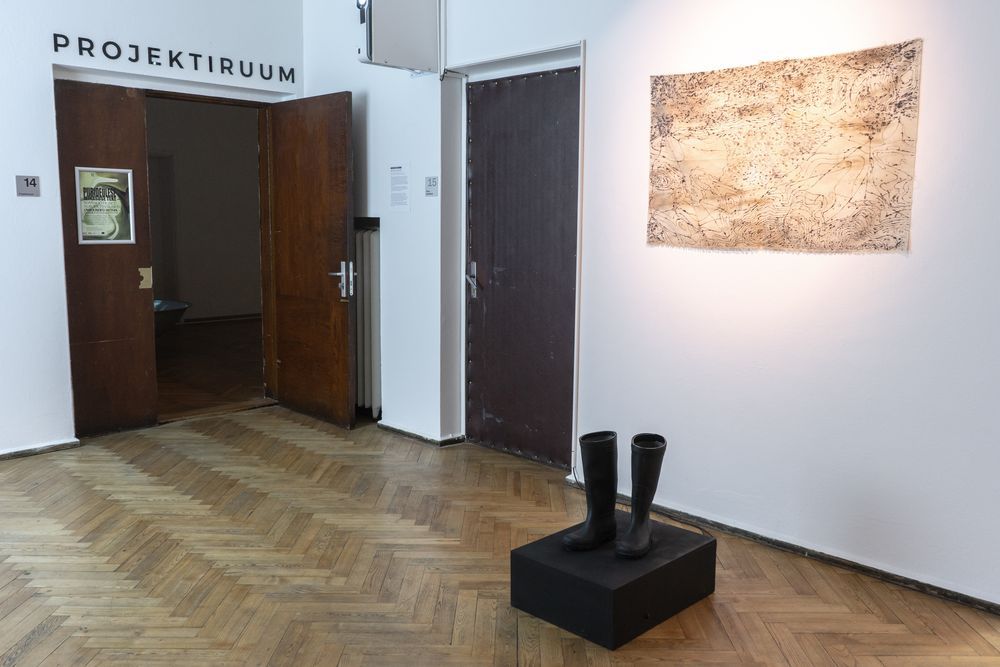
Image 4: Map (2025) and Certain Aspects of Unsteady Walking (2023) by Maria Nalbantova (Image Credit: Anna Birgitta Erikson)
Maria Nalbantova, the artist in residence for the Bulgarian Action Site, Dragoman Marsh, presented two works, Map (2025) and Certain Aspects of Unsteady Walking (2023). Map interprets an early 20th-century topographic map showing the territory of Dragoman Marsh and its surroundings before it was drained. Soaked in the marsh for six months, the canvas absorbed the site's organic matter, becoming a gesture of overlap between historical archives and physical memory. Map exists in the space between erasure and restoration. The second piece presents camera trap footage from the Dragoman Marsh, projected through boots worn by Nalbantova during fieldwork. Boots designed to protect against the unpredictable terrain of the wetland, where punctures are always possible, become a frame for what happens when humans are not there. Inside, life unfolds in their absence. Outside, the boots remain evidence of presence.
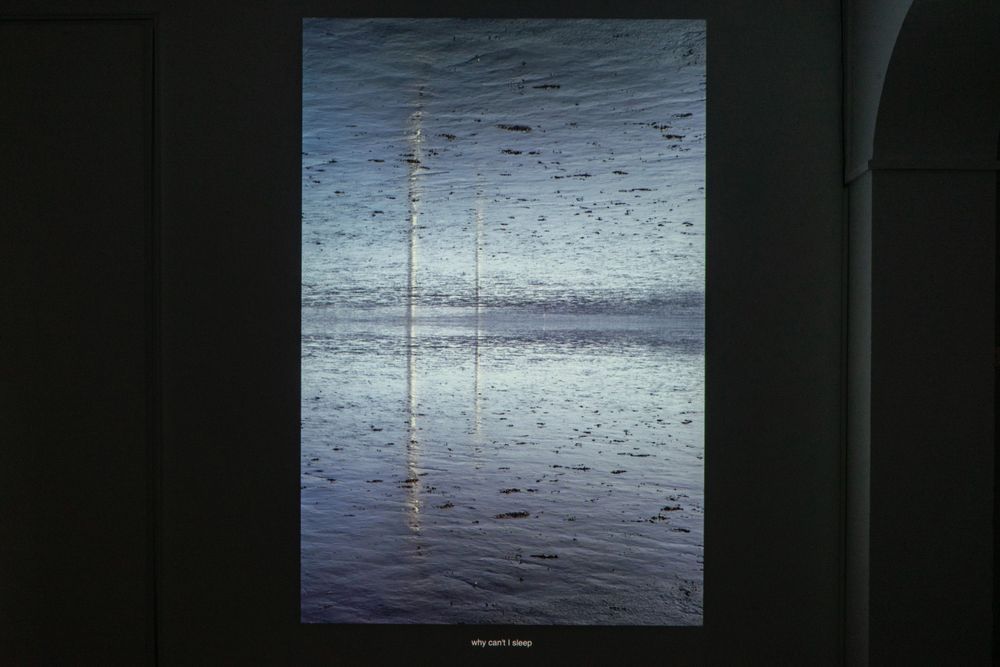
Image 5: Tera Clouds (2026-ongoing) by Marjolijn Dijkman (Image Credit: Anna Birgitta Erikson)
Marjolijn Dijkman has been working on the Netherlands Action site at the Eems Dollard estuary. Alongside some older pieces, Marjolijjn presented Tera Clouds (2026-ongoing), a reflection on the interconnection of the paradigm of modernity, high speed data infrastructures and the estuary itself. The piece shows mirrored silt surfaces which reflect clouds and 25 windmills powering the Eemshaven Google data center (Europe4), whose cooling water enters the estuary. They evoke 17th-century Dutch landscape paintings and the era windmills first reclaimed the tidal coastline. Turbid waters still carry centuries of consequences. Sound blends windmill hums, cooling water discharge, and field recordings. The text is composed of top global Google searches, with 'what time is it' leading, queries traveling via submarine cables to the same waters the data center warms.
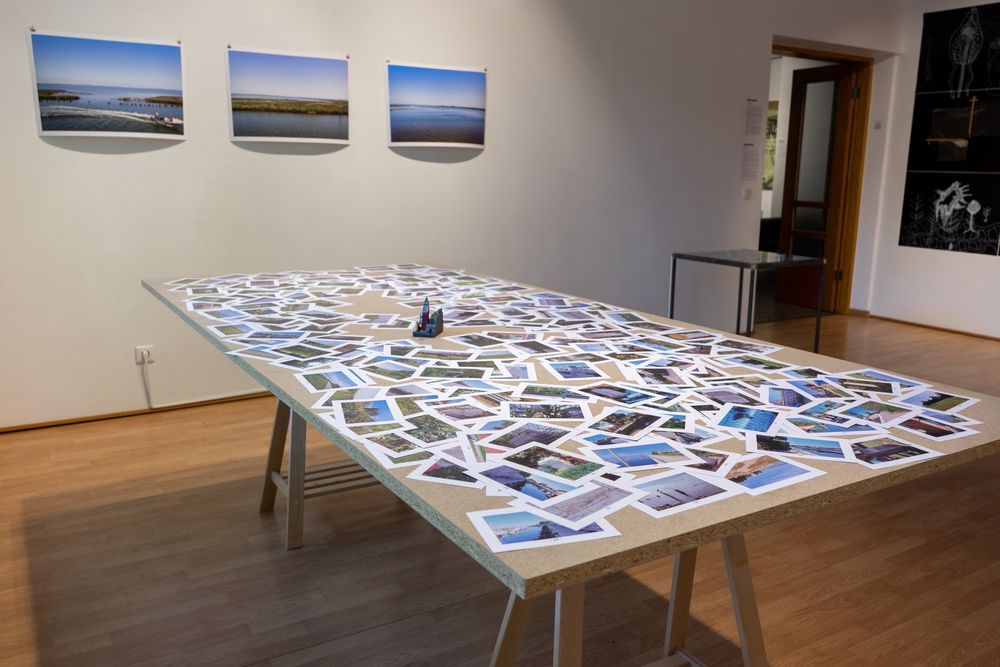
Image 6: La Laguna Dei Cippi (2024-ongoing) by Claudio Beorchia (Image Credit: Anna Birgitta Erikson)
Claudio Beorchia presented La Laguna Dei Cippi (2024-ongoing) developed as part of his residency with the Italian Action Site, the Venice Lagoon. The work addresses the boundary stones (cippi), one hundred of which have defined the borders of the Lagoon since the 18th century. They are a legal and administrative perimeter, but also a geographical and landscape one, that seeks to draw a line between water and land. They have observed the Lagoon and the evolution and transformation of its edges. Since 2024, through a participatory project, Claudio Beorchia has sought to answer the question, what view of the Lagoon do the cippi bear witness to? Through the involvement of a diverse group of people as active researchers — local residents, enthusiasts of the Lagoon environment, and visitors — a body of images and audio recordings have come to life, showing the Venice Lagoon from the perspective of these boundary stones.
Participating artists in the exhibition: Marjolijn Dijkman (NL/BE), Feral Practice (UK), Laura Harrington (UK), Maria Nalbantova (BUL), Claudio Beorchia (ITA), Toril Johannessen (NO), Christine Mackey (IRL), Alyona Movko-Mägi (EST), Kristina Norman (EST), Elo Liiv (EST), Martin Menert (EST) and Anna Birgitta Erikson (EST).
The exhibition was supported by the Cultural Endowment of Estonia, the City of Pärnu, and WaterLANDS.